Walk into many churches, halls and event venues across Africa and you will see the same microphone doing every job. It is used for the pastor, the lead singer, the choir, the kick drum and the guitar amplifier. Things have improved a lot in recent years, but choosing a microphone is still too often based on what the shop had, not on what the job needs.
In truth there is a microphone, often several, designed for each application. Knowing the basics will save you money, feedback and frustration.

Dynamic or condenser
- Dynamic microphones are robust, handle very loud sources and need no power. They need the source close to the capsule. Typical uses: vocals on a loud stage, drums, guitar amplifiers, speech in noisy places.
- Condenser microphones are more sensitive and capture more detail, but they also pick up more of the room. Most need phantom power (48V) from the mixer. Typical uses: lecterns and goosenecks, choirs, acoustic instruments, drum overheads, studio vocals.
Polar pattern: where the microphone listens
The polar pattern shows how sensitive a microphone is from each direction. This is one of the most important specifications, and one of the least understood.
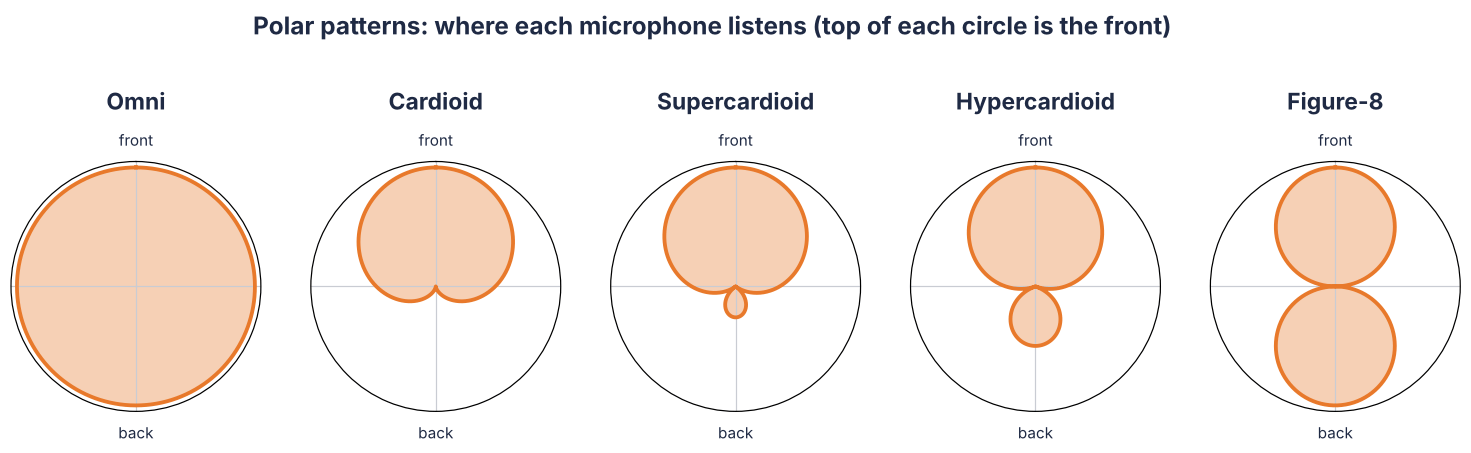
- Omnidirectional: hears all around equally. Good for lavaliers on presenters and some recording, poor on a loud stage because it picks up the speakers too.
- Cardioid: hears the front, rejects the back. The most common choice for vocals and speech. Place the stage monitor directly behind it.
- Supercardioid and hypercardioid: narrower at the front, with more side rejection and a small pickup lobe at the back. Better gain before feedback on loud stages, but the monitors must be placed at an angle, not directly behind.
- Figure-8: hears front and back equally and rejects the sides. Mostly used in studios.
Other specifications worth reading
- Sensitivity: how much signal the microphone gives for a given sound level, usually in mV/Pa or dBV/Pa. Condensers are more sensitive than dynamics, so they need less gain from the mixer.
- Maximum SPL: how loud a sound the microphone can take before it distorts. Important for kick drums, brass and guitar amplifiers.
- Frequency response: vocal microphones often have a lift in the upper mids for clarity. Kick drum microphones are shaped for low frequencies. Instrument microphones are often flatter.
- Proximity effect: directional microphones add bass as the source gets closer. Good singers use it. Speakers who swallow the microphone sound boomy.
A microphone for each job

| Application | What usually works |
|---|---|
| Lectern or pulpit | Gooseneck condenser, cardioid or supercardioid |
| Boardroom table | Gooseneck or boundary microphones, or ceiling microphones with a DSP |
| Pastor or presenter who moves | Headset microphone for loud rooms, lavalier for TV and quiet rooms |
| Lead vocal | Handheld cardioid or supercardioid vocal microphone, dynamic or condenser |
| Choir | Small diaphragm condensers placed above and in front of the choir |
| Kick drum | Large diaphragm dynamic designed for low frequencies |
| Snare and toms | Instrument dynamic microphones or clip-on drum microphones |
| Drum overheads | Pair of condenser microphones |
| Guitar amplifier | Instrument dynamic microphone close to the speaker |
| Keyboard and bass | Usually a DI box, not a microphone |
The fake microphone problem
Then there is the market. Many people buy a “branded” microphone in town and truly believe it is original. Here is a simple test. A Shure SM58, one of the most copied microphones in the world, sells for around 100 US dollars in the US. If you are offered one in Kampala for 20 dollars, it is not genuine. Not new, and not even used. No official distributor can buy it at that price.
Counterfeiting is organised and large. In one recent case, Shure and other audio brands worked with investigators in China against a network running more than 80 online stores. Nearly 900,000 dollars of the fake sales were Shure products alone. Shure itself warns that fakes often use genuine photos and specifications, and that an unusually low price is a warning sign. Their advice is simple: buy from an authorised dealer.
A fake does not just sound worse. It often fails early, handles feedback badly, and has no warranty. You pay twice.
Is a 1,000 dollar wireless system expensive?
Many clients tell me a wireless system over 1,000 dollars is too expensive. But that is not a Ugandan price, it is the market. One large US retailer lists dozens of Shure wireless systems between 3,000 and 5,000 dollars, and many above that. Professional digital wireless gives you stable signal, encryption, rechargeable batteries, network monitoring and the ability to run many channels together without interference. For a church, a conference centre or a parliament, that is what you are paying for.
Local support, and the frequency trap
Last, and often forgotten: who will support your microphones next year?
Wireless microphones are sold in frequency bands, and the legal bands differ from country to country. Shure states clearly that a wireless system sold in one region may not be legal in another. In Uganda, the radio spectrum is regulated by the Uganda Communications Commission. A system bought in the US is built for US frequencies.
To give a real example, the Audio-Technica 3000 Series is sold in different bands, including DE2 (470 to 530 MHz) and EE1 (530 to 590 MHz). A transmitter from one band will not work with a receiver from the other.

Now imagine your handheld transmitter is lost, stolen, dropped or dies. If you bought the system locally from the official distributor, in most cases you can buy just that one transmitter, in the right band, and carry on. If you imported it from abroad, you may find the same model, but in a different band, and it will not work with your receiver. Then you are buying a whole new system.
- Choose the microphone for the job, not one microphone for all jobs.
- Buy from the official distributor or an authorised dealer.
- If the price is too good, it is not original.
- For wireless, make sure the band is right for Uganda and that spare transmitters, capsules and batteries are available locally.
If you need help choosing microphones for a church, hall, boardroom or stage, Talk to us at PRO AV Africa or message me on WhatsApp.
References
- Tell me about wireless microphone frequencies, Shure
- How to avoid fake Shure microphones and earphones, Shure
- Shure victory against counterfeiters, Audioholics
Photo: Unsplash. Product images: Audio-Technica. Diagram: Boaz Shani.