This subject has been on my mind for a very long time.
In Uganda, so many churches don’t really have sound systems. They have noise generation systems.
The reason is simply a lack of exposure and education, for both the church administration and the “sound man” or “sound technician”.
I put those titles in quotation marks because about 90% of church “sound men” were never trained by a sound professional. Most of them were trained by a mzee (an older person), who was trained by another mzee, who was never trained by anyone.
The work of a sound man is more than setting up the system and making it work.
- How many sound people in Uganda know the impedance of their speakers and amplifiers?
- How many know what a microphone’s polar pattern is?
- How many can identify a frequency and kill feedback in a second?
- And how many can stand up to their pastor and church administration and say: no, this is wrong?
I will publish an article on each of those questions in future. For now, let’s go back to the main topic: sound systems.
It is sad that in so many churches in Uganda, the sound is not really sound. It is loud noise.
Many churches use speakers that are too big, made for outdoor concerts. Many others are simply fake. When they are bought, nobody looks at the specifications. What frequency range does the speaker cover? How intelligible is it?
What is intelligibility? It is how clear the speaker’s sound is. Yes, it can be measured, and it is very important when you buy speakers.
Think about it: how many times have you simply not understood what came out of the speakers?
In Uganda everyone likes big. People think the bigger, the better. This is wrong!
If you have visited churches around the world, you will notice that you hardly ever see the speakers. Why? Churches are buildings where acoustics are hard to manage, and one of the best ways to manage them is with many small speakers, so the sound does not come from one main set and bounce all over the room.
As far as I know, people come to church for two things: to listen to the word and to enjoy the gospel music. Not to attend a live concert or a night club.
If you agree with me, why can’t you clearly hear the words of your priest or pastor?
Another problem is that many preachers spent years preaching without a sound system, so when they finally get a microphone they keep shouting into it. That does not help either.
Did you know that most singers, politicians and public speakers are trained to hold and use a microphone and a sound system? I am not sure church sound men know how to train anyone, and if they do, whether they have tried.
The bottom line is this: in church it should not be about how loud the system can get, but how clear and audible it is.
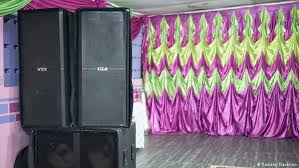
I am not saying it should not be loud, or that there should be no subwoofers. But a church does not need subwoofers the size of two big people (my size). A church can have clear sound that everyone enjoys, where every word is understood.
Some churches have bought good sound systems but struggle to manage and set them up. And remember, a sound system is a system: everything must work together.
If you have great original speakers and amplifiers but your sound man is not great, the sound won’t be great. If you have great original speakers, amplifiers and a good sound man, but the microphones are wrong for the application, or the cables or connectors are fake, there will always be problems during the service.
It is sad that in our local market, the shops that sell speakers and sound systems mostly sell fake or locally assembled speakers. More important to me, nobody in those shops can explain how to choose equipment or what to look for. They just want to sell. The result is that churches keep coming back to buy again, because the gear does not last or does not perform.
Let me ask you this. When you need parts for your car, you look for value, but if a part keeps failing you eventually buy the original. It costs a bit more, but you know it will last.
So why don’t people see yet that cheap is expensive?
When a church buys speakers three or four times a year because they keep blowing or don’t perform, why not invest once? It would surely cost less than going back to the market three times.
Another problem churches face is, sadly, corruption. Yes, even some churches in Uganda. I may come to consult a church, and the next day other “advisors” who know nothing about sound pretend they do, when their main aim is to get something out of the deal.
I think there are only five or so people in Uganda who really know how to design sound systems for churches.
We offer free training to churches, so they have the right tools when they look for a sound system and can compare different systems the right way.
I have seen it many times. People come to me wanting big speakers, or 5,000 watt speakers. After I teach them a few things and give them a demo, they are confused at first, but then they agree that they did not know all this before and that it makes sense.
I hope that in a few years, churches in Uganda will have the right sound systems, and that people will appreciate and demand better sound, not only in churches but everywhere: schools, weddings, parties, night clubs and more.