Category: Projection and displays

  • Square screens, 4K projectors and laser TVs: the boardroom display mistakes we keep seeing

    Square screens, 4K projectors and laser TVs: the boardroom display mistakes we keep seeing

    A client calls. They have just bought a new Full HD projector for the boardroom. The picture looks small, there are grey bands at the top and bottom, and the text still looks soft. When we visit, we find the problem in two minutes. The projector is new, but the screen on the wall is an old square tripod screen, or a 4:3 screen from the days of overhead projectors.

    This happens a lot. And it sits next to two other habits I see every week: asking for a 4K projector for a boardroom because the TV at home is 4K, and buying a “laser TV” with its grey home cinema screen for a meeting room. All three come from the same place. People buy the product, not the result.

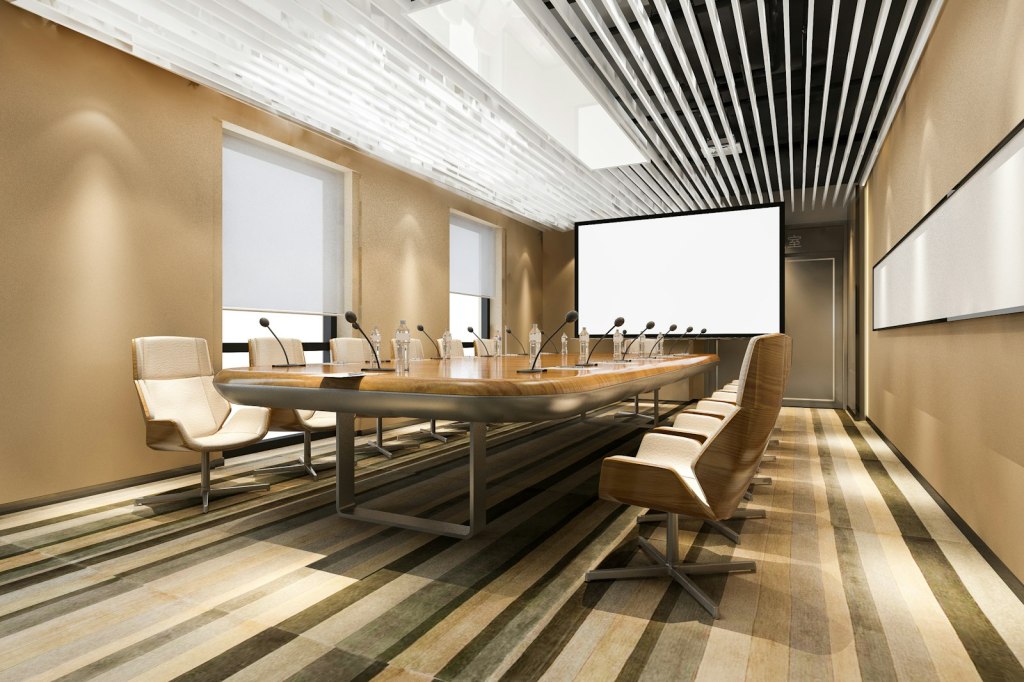
    Conference room with a projection screen at the end of the table
    A boardroom projection screen should match the projector, the content and the farthest seat in the room.

    Aspect ratio in plain words

    Aspect ratio is simply the shape of the picture: width compared to height. A 4:3 picture is almost square. A 16:9 picture is the wide shape of every TV and laptop today. A 1:1 screen is a perfect square.

    • 1:1 square screens come from the era of slide projectors and overhead projectors, when the image could be portrait or landscape. They have no place in a modern meeting room.
    • 4:3 was the shape of old computer monitors and XGA projectors (1024 x 768).
    • 16:10 is the native shape of WUXGA projectors (1920 x 1200), the most common resolution in business and education projectors today.
    • 16:9 is the shape of Full HD (1920 x 1080) and 4K UHD (3840 x 2160), and of most laptop output and video calls. PowerPoint also uses 16:9 as its default slide size.

    Now put a 16:9 picture on a square screen. If the picture fills the width, it uses only 56% of the screen. On a 4:3 screen it uses 75%. The rest is empty grey or white space, and the picture is smaller than the screen you paid for. If you try to fill the height instead, the picture spills off the sides and onto the wall.

    Diagram of a 16:9 picture on 1:1, 4:3, 16:10 and 16:9 screens
    The same 16:9 laptop picture on four screen shapes. Only a 16:10 or 16:9 screen uses the space properly.

    The rule is simple. Match the screen to the projector and the content. A WUXGA projector goes with a 16:10 screen. A Full HD or 4K projector goes with a 16:9 screen. A 16:10 screen also works well with 16:9 content, with only thin bands top and bottom.

    Vivitek DU3661Z WUXGA laser projector
    A WUXGA laser projector such as the Vivitek DU3661Z has a native 16:10 picture, so it belongs with a 16:10 screen.

    Size the screen to the last seat, not the wall

    The second mistake is size. The screen should be chosen from the distance to the farthest viewer and the kind of content, not from how much wall is free. An old rule of thumb in our industry said the farthest viewer should sit no more than about six times the picture height away for general viewing, and closer for detailed content like spreadsheets. Today AVIXA publishes a proper standard and a free calculator for this, called DISCAS. A good integrator will use it before choosing the screen and the projector.

    4K in the boardroom: who is it really for?

    The second habit is resolution. The TV at home is 4K, the phone shoots 4K, so the boardroom must have a 4K projector. It sounds logical, but in most meeting rooms it does not change what people see.

    • Viewing distance. Resolution only helps if your eye can see the extra detail. From three to six metres back, on a typical boardroom screen, most people cannot tell 4K from a good WUXGA picture when they are looking at slides, emails or a video call.
    • The content. Presentations use big text and simple graphics. Most video calls arrive at Full HD or lower. Many laptops are set to output 1080p. A 4K projector cannot add detail that is not in the signal.
    • Not all “4K” is native. Many affordable 4K projectors use a Full HD or similar chip and shift the pixels very fast to create a 4K image on screen. It can look very good, but it is not the same as a native 4K panel, and native 4K models cost far more.
    • The money. The difference in price is better spent on brightness, a laser light source, a proper screen, good microphones and sound, or a better camera for video calls. Those are the things people in the room actually notice.

    4K does have its place: engineering and architectural drawings, medical images, detailed maps in control rooms, large screens viewed from close up, and of course cinema. If that is your content, we will specify it. If your boardroom runs PowerPoint, Excel and Teams, spend the money where it shows.

    The laser TV in the boardroom

    The third habit is newer. Someone sees a “laser TV” in a showroom or online: an ultra short throw laser projector that sits on a cabinet under the wall, sold together with a special grey screen. It looks stunning in a living room, so it gets bought for the boardroom.

    Those screens are called ALR, ambient light rejecting. They are clever: their surface reflects the light coming from the projector below back towards a viewer sitting in front, and rejects light coming from above, like ceiling lights. The product is designed around a family sitting on a sofa watching a movie. That is exactly why it is often the wrong choice for a meeting room.

    • Viewing angle. These screens are at their best for viewers sitting in front. People at the far ends of a long boardroom table see a dimmer picture with shifted colours.
    • Content. Movies are mostly mid tones and dark scenes. Slides are mostly white backgrounds with text. A darker grey home cinema surface is tuned for the first, not the second.
    • Size and position. The screen size is fixed, and the projector must sit at an exact distance below it. You cannot easily move to a bigger screen later, and the projector needs a cabinet where a credenza or a presenter normally stands.
    • Built for homes. Smart TV apps and built-in living room speakers are not what a boardroom needs. Control from a room system, fixed inputs and long daily use matter more, and the warranty terms are often written for home use.

    There are good ultra short throw projectors and good ALR screens made for business and education. The point is to choose them for the room and the content, not because they looked good in a living room.

    Start from the room, not the product

    Before you buy any display, answer these questions:

    • What will be shown most of the time: slides, spreadsheets, video calls, drawings or video?
    • How far is the farthest seat from the screen?
    • How bright is the room, and can the lights and blinds be controlled?
    • What is the native shape of the projector, and does the screen match it?
    • Who will support the system locally when something goes wrong?

    Get those right and a Full HD or WUXGA laser projector on the right screen will beat an expensive 4K projector on the wrong one, every time.

    If you are planning a boardroom, classroom or hall and want the display chosen properly, from screen shape to brightness, Talk to us at PRO AV Africa or message me on WhatsApp.

    References

    Photo: Unsplash. Product image: Vivitek. Diagram: Boaz Shani.
  • Don’t say no to projectors. Say no to cheap ones.

    Don’t say no to projectors. Say no to cheap ones.

    More and more briefs I receive say the same thing: “No projectors.” Schools, churches, boardrooms and halls now ask for an LED wall, a large flat screen, or an LCD video wall instead. When I ask why, the answer is nearly always the same. For years they used a cheap lamp projector, the picture was dim, the lamp kept dying, and they are tired of it.

    I understand the feeling. But throwing out projectors because of a cheap projector is like a company that buys a cheap Wi-Fi router, suffers dropped connections and daily restarts, and then decides Wi-Fi does not work and wires every desk with cable. The problem was never Wi-Fi. It was the router. Put in a proper business access point and the experience is on another level. Projectors are the same.

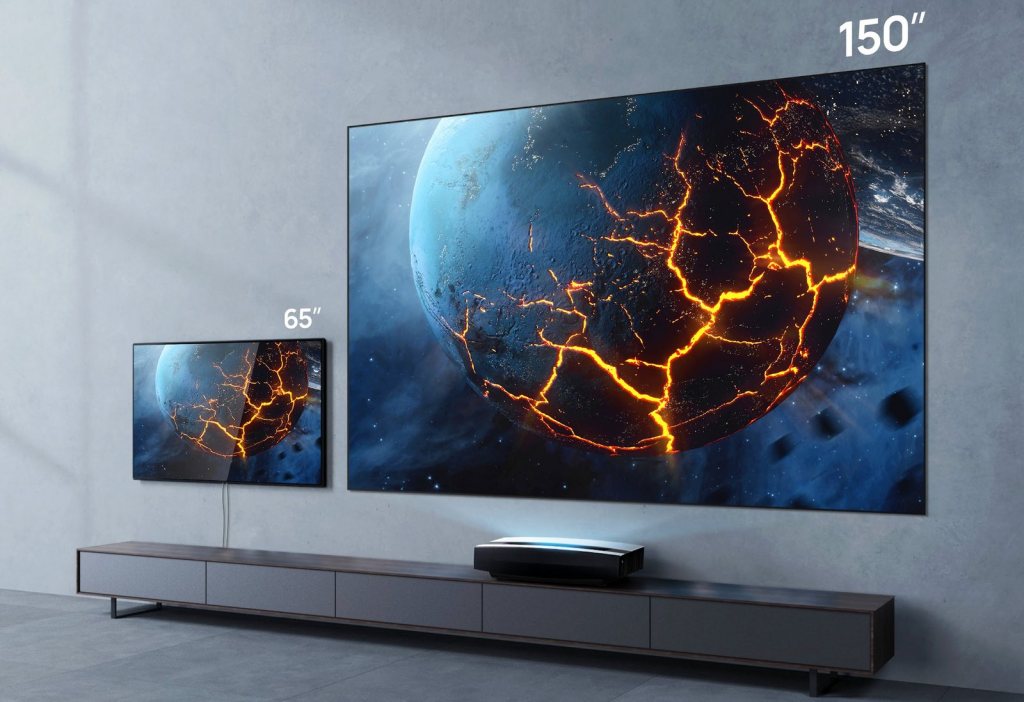
    Ultra short throw laser projector showing a 150-inch picture next to a 65-inch TV
    Same wall, same cabinet. A 65-inch TV next to a 150-inch picture from an ultra short throw laser projector. No flat screen gets near that size for the money.

    What people are comparing

    Before deciding, it helps to know what each option really is.

    • Projector: throws an image onto a screen. Gives the biggest picture for the money. Picture quality depends heavily on brightness, the room light and the screen.
    • LFD (large format display): a professional flat screen, typically 55 to 110 inches, built to run long hours. Bright and sharp, but the size is limited.
    • LCD video wall: several thin-bezel professional screens joined together. Large and bright, but with thin lines between the panels.
    • DvLED (direct view LED): an LED wall built from modules, with no lines and no size limit. Excellent brightness and impact, and by far the highest cost per square metre.
    DvLED video wall in a boardroom
    A DvLED wall in a boardroom: seamless, bright and impressive, and the highest cost per square metre of all the options.

    The DvLED reality check

    DvLED is a great technology and we design with it often. But many clients do not realise what a good LED wall costs, so they shop for a cheap one. That is where the trouble starts.

    • Spare parts disappear. Import an LED wall from just any factory, and in one or two years you may not find that factory, that module or that driver card again. One dead module and there is a hole in your wall.
    • Colours stop matching. LEDs are sorted into batches by colour and brightness. Modules from a different batch can look slightly different next to the original ones. Even the big brands find this hard, so they keep spare modules from the same batch. A cheap supplier usually does not.
    • Real brightness and life. The whole point of LED is a bright, sharp, long-lasting picture. Cheap walls are often dimmer than advertised, fail sooner, and have no local support.
    • The budget. For the price of one good LED wall you can often install a top laser projector, a quality screen and proper sound, and still have money left.
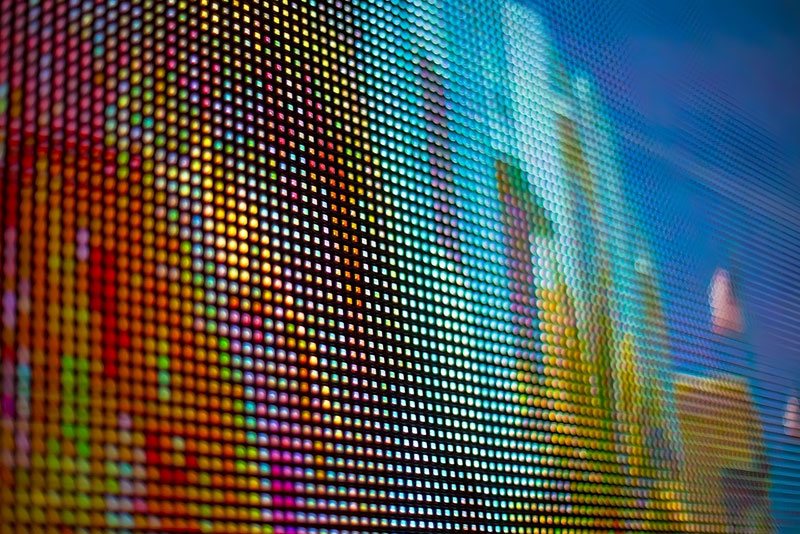
    Close-up of LED wall pixels
    Up close, an LED wall is thousands of tiny LEDs on modules. Replace one module from a different batch and you can see the difference.

    With a recognised brand you will still face some of these issues, but you will have a supplier who stands behind the product. That is the difference.

    A cheap projector is not the same as a good one

    A projector that costs one or two million shillings will never perform like a professional installation projector. The problem is that most people have only ever seen the cheap end, so they think that is what projectors are. Here is what to look at before you buy.

    1. Brightness, the honest number

    Projector brightness should be measured in ANSI or ISO lumens, using the international ISO 21118 method. Many cheap projectors sold online advertise 5,000, 9,000 or even 12,000 “lumens” for $100 to $300. That is not possible. Some list “lux” or “LED lumens” instead, which are not the same thing at all.

    This is not just my opinion. Epson has taken several online sellers to court in the US over exaggerated brightness claims. In 2024 a court awarded Epson more than $500,000 against one Amazon seller, AuKing, and other brands have agreed to correct their specifications after Epson sued. If a deal looks too good, the brightness number is usually the reason.

    2. Resolution

    Old XGA (1024 x 768) projectors are why so many people think projected text looks soft. Today WUXGA (1920 x 1200) is the sensible minimum for classrooms, boardrooms and churches, and 4K is available where detail really matters.

    3. Lamp or laser

    This is the biggest change in projectors in recent years. A lamp projector’s lamp typically lasts about 3,000 to 6,000 hours at full power before it drops to half brightness, and lamps often fail earlier than rated. Over ten years you can expect two to four lamp changes, each one costing money and downtime. A laser projector is typically rated at about 20,000 hours, with little or no maintenance in between.

    Laser also switches on and off almost instantly. There is no warm-up and no cool-down. In Uganda, where the power goes off without warning, that matters. A lamp projector that loses power while hot has no chance to cool its lamp properly, and that shortens lamp life. Laser simply comes back on when the power returns.

    4. Dust: DLP or 3LCD

    Our rooms are dusty, and dust is a projector’s enemy. Projectors use two main imaging technologies. Single-chip DLP projectors usually have a sealed light path, so dust cannot settle on the imaging chip, and many models need no filter at all. 3LCD projectors produce excellent colour, but they draw air through the optics and depend on a clean filter. Neither is wrong, but in a dusty school or church without regular maintenance, a sealed DLP or a laser model with a long-life filter will give you fewer problems.

    5. Hours, warranty and who supports it

    Look at the rated hours, the filter life and the warranty, and ask who services it locally. Several manufacturers make education ranges built for long school days, often with longer warranties. A projector is only as good as the after-sales support behind it.

    Projector range with 5 year warranty for education and large venue models
    Some manufacturers now give five years warranty on their education and large venue ranges. Ask what applies locally before you buy.

    Throw types: where the projector sits

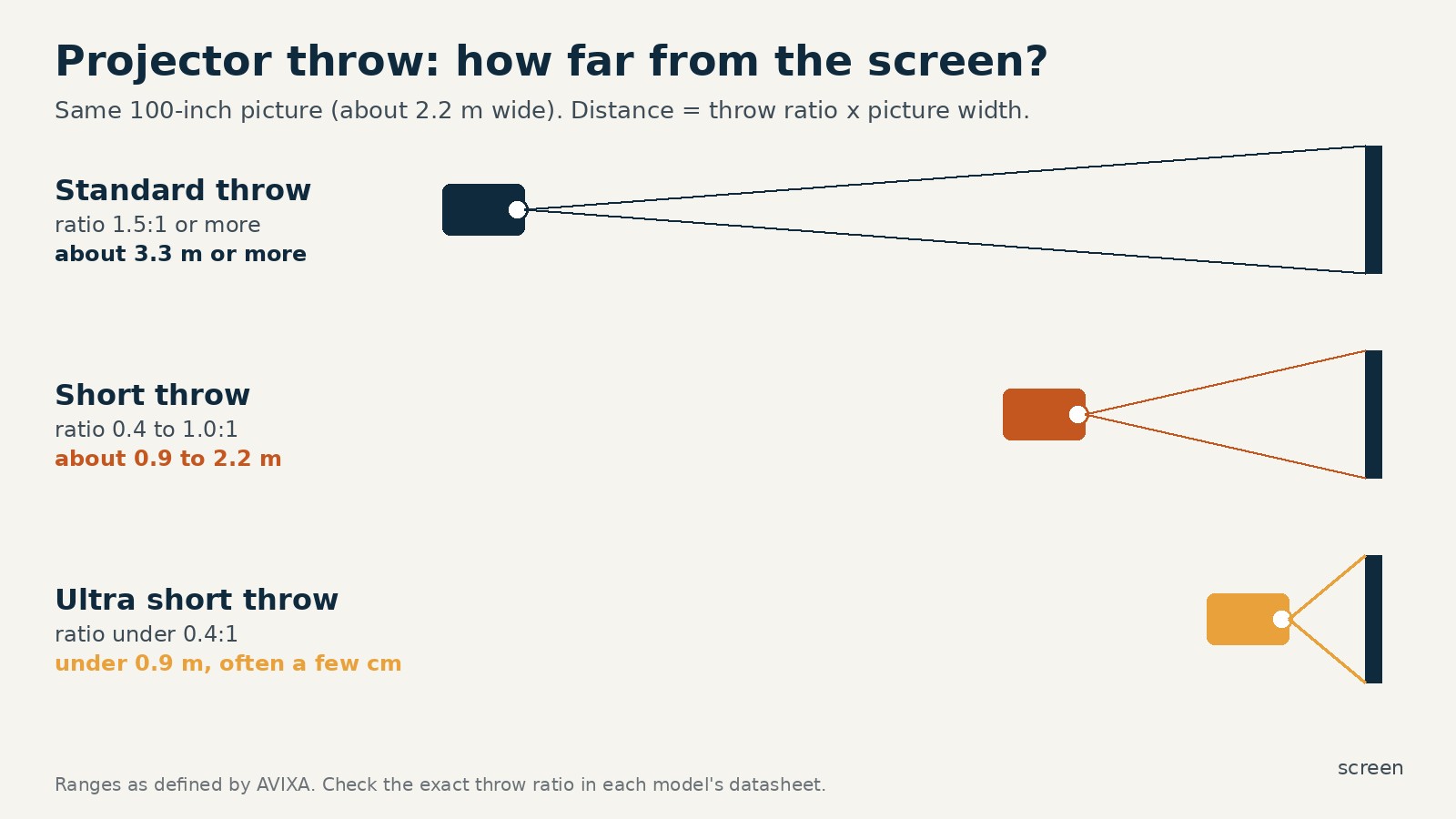
    The throw ratio tells you how far the projector must be from the screen. Multiply the ratio by the picture width and you get the distance.

    Diagram of standard, short and ultra short throw projector distances
    Same picture size, three very different mounting positions.
    • Standard throw (1.5:1 or more): mounted at the back or middle of the room. Best for halls, churches and auditoriums.
    • Short throw (about 0.4 to 1.0:1): a big picture from close up. Fewer shadows on the presenter and less glare in their eyes.
    • Ultra short throw (under 0.4:1): sits just above or below the screen, often only a few centimetres away.
    Auditorium with a large projection screen and line array speakers
    Halls and auditoriums are standard throw territory: the projector sits at the back and fills a large screen above the stage.

    Where ultra short throw makes sense

    • Classrooms: the teacher stands at the board without casting a shadow or looking into the light. Many UST models are interactive, so the whiteboard becomes a touch surface.
    • Small meeting rooms: a large picture with nothing hanging from the ceiling.
    • Homes: a 100-inch-plus picture from a unit on a low cabinet, with an ambient light rejecting screen for daytime viewing.
    • Shop windows and displays: the projector hides close to the surface.
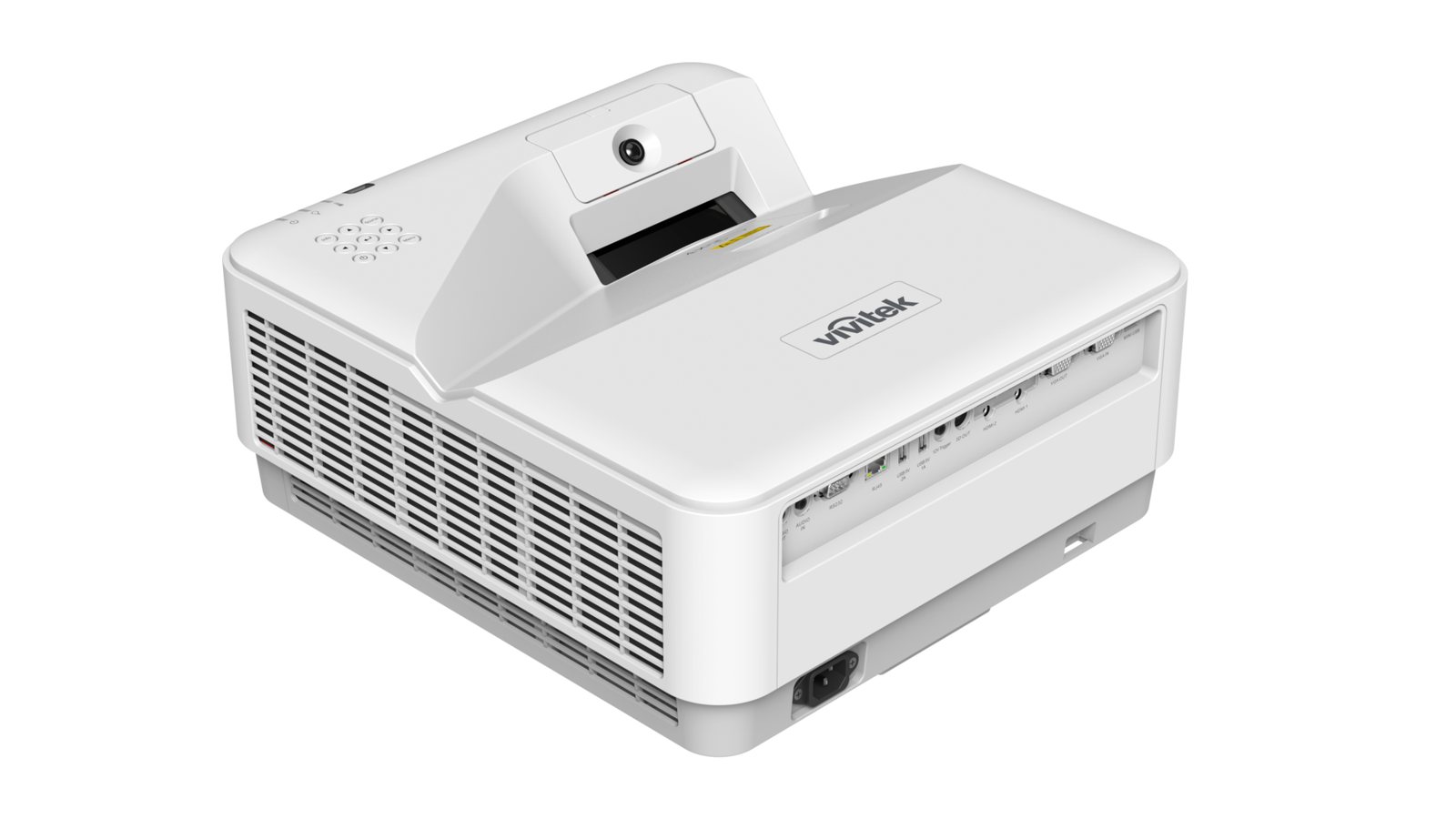
    Interactive ultra short throw laser projector
    An interactive ultra short throw laser projector. The sensor on top turns the whiteboard into a touch surface.

    What no screen can do

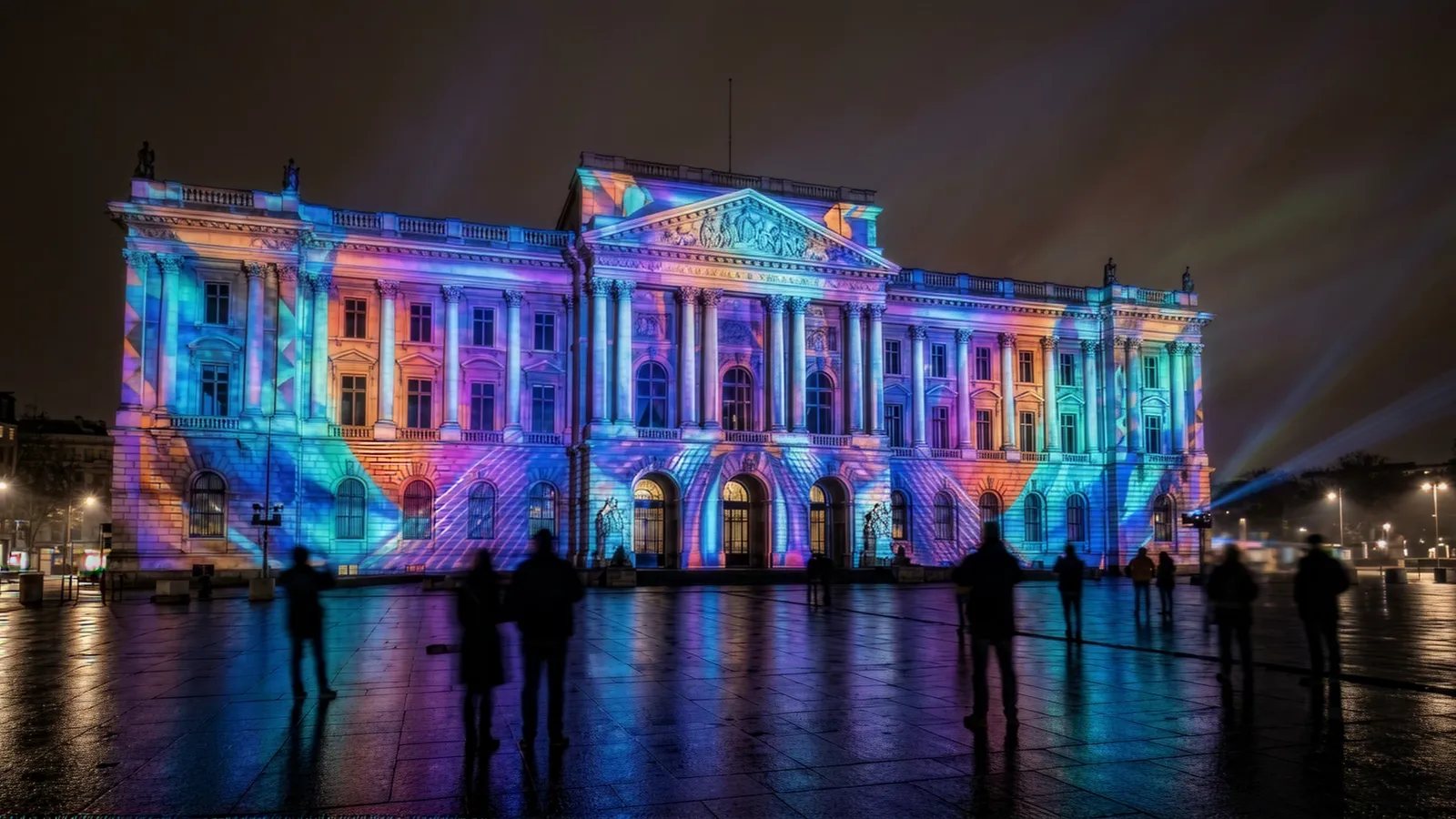
    There is also a whole side of projection that flat screens and LED walls simply cannot do. Projection mapping turns a building, a stage set, a car or an odd-shaped wall into a moving picture. The surface does not need to be flat, and when the show is over the building is just a building again. For product launches, national celebrations, festivals and events, nothing else comes close.

    Projection mapping on the front of a historic building at night
    Projection mapping on a building front. Only projectors can do this.

    So what should you choose?

    Every technology has its place. LFDs suit small and medium rooms. LED walls are right for big impact, bright spaces and when the budget is there. But a good laser projector sits in between, in picture size, in quality and in cost. For most classrooms, meeting rooms, lecture halls and churches, it gives a bigger picture than an LFD and a lower cost than DvLED, with years of maintenance-free use.

    So please, do not write “no projectors” in your next brief. Write “no cheap projectors”. Then let us show you what a proper one can do.

    If you are planning a classroom, hall, church or boardroom and want honest advice on projector, LFD or LED, talk to us at PRO AV Africa or message me on WhatsApp.

    References

    Images: manufacturer and industry sources. Throw diagram: Boaz Shani.